By OrbTimes International Desk | March 2026
The Middle East has entered one of its most dangerous military confrontations in decades as Iran faces a large-scale military campaign launched jointly by the United States and Israel. The conflict, which began on February 28, 2026, has rapidly escalated into a regional crisis affecting multiple countries across the Middle East.
Iranian officials say the campaign is aimed at weakening the country’s military infrastructure and forcing political change in Tehran. However, Iranian leaders describe the attacks as an unprovoked act of aggression and have vowed to defend the country’s sovereignty while retaliating against U.S. and Israeli assets in the region.
Massive Airstrikes Across Iran
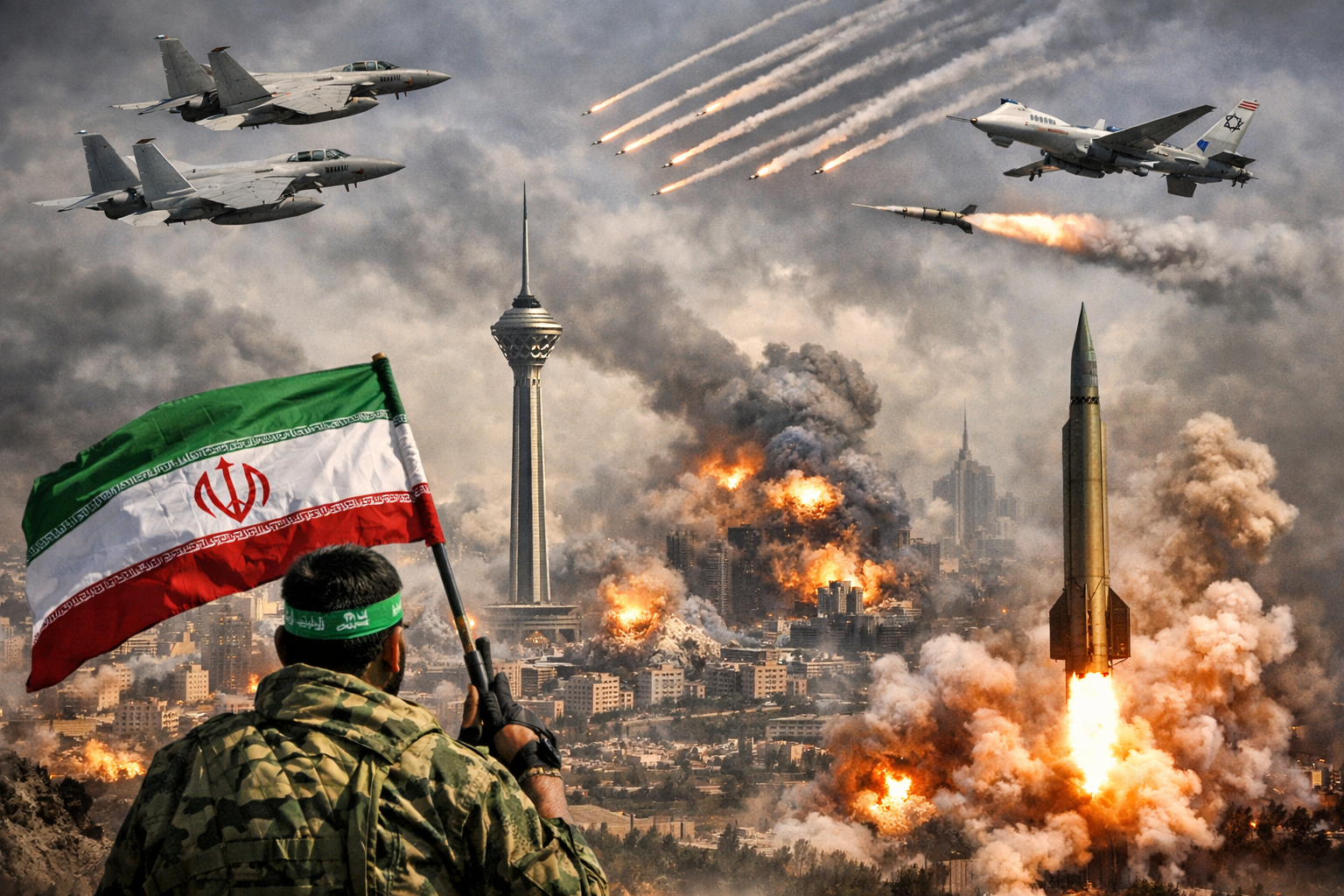
The war began when the United States and Israel launched coordinated air and missile strikes against Iranian targets under a joint military campaign. Explosions were reported in Tehran and several other cities as military facilities, government installations, and infrastructure sites were targeted.
According to military reports and international monitoring organizations:
- More than 2,000 targets have been attacked by U.S. forces during the first days of the campaign.
- Israeli forces reportedly used over 4,000 munitions in airstrikes across Iran.
- At least 170 separate strikes were recorded across 19 Iranian provinces during one 24-hour period alone.
The attacks mark one of the largest military operations against Iran since the Iran-Iraq War of the 1980s.
Rising Civilian Toll
The humanitarian impact of the conflict has been severe. Iranian authorities report significant civilian casualties and widespread damage to infrastructure.
Latest available figures indicate:
- More than 1,200 people killed in Iran since the beginning of the attacks.
- Over 6,000 people injured across the country.
- Thousands displaced as residents flee major cities including Tehran.
One of the deadliest incidents occurred when a strike reportedly hit a school in southern Iran, killing more than 160 people, many of them children, according to humanitarian reports.
International health organizations have also warned about attacks affecting hospitals and healthcare facilities, raising concerns about the war’s humanitarian consequences.
Iran’s Retaliation
Iran has responded with missile and drone attacks targeting Israeli territory and U.S. military installations across the region. Military analysts say Tehran’s response is part of a broader strategy to deter further strikes and demonstrate its regional capabilities.
Iran’s counter-operation, reportedly called “True Promise IV,” has included ballistic missile launches and attacks on military bases in the Gulf region.
The conflict has also expanded beyond Iran’s borders. Armed groups allied with Iran, including forces in Lebanon, have reportedly launched attacks against Israeli positions in northern Israel.
A Regional War in the Making
The fighting is no longer confined to Iran and Israel. The conflict has already spread across several countries in the Middle East, raising fears of a broader regional war.
According to international organizations:
- Casualties have been reported in Iran, Israel, Lebanon, and several Gulf states.
- More than 100,000 people have fled Tehran, while tens of thousands have been displaced in Lebanon.
- Military tensions are rising across the Persian Gulf, Iraq, Syria, and Lebanon.
Analysts warn that continued escalation could threaten global energy supplies and destabilize the wider region.
Political Fallout in Washington and Worldwide
The war has also triggered political debate in the United States. In Washington, lawmakers have argued over whether the military campaign should have required congressional authorization.
Despite the controversy, the U.S. House of Representatives recently rejected a resolution that would have limited the president’s authority to continue the military operations against Iran.
Meanwhile, governments around the world have called for urgent de-escalation, warning that the conflict could spiral into a wider international crisis.
Iran’s Message: Resistance
Iranian leaders have framed the war as a struggle for national independence and resistance against foreign intervention. Officials insist that the country will continue to defend its territory and retaliate against attacks.
“We will respond decisively to any aggression,” Iranian officials have repeatedly stated, warning that the war could expand if attacks continue.
With both sides showing little willingness to back down, the coming weeks may determine whether this confrontation remains a limited conflict—or evolves into a full-scale regional war.